Freehold vs. Leasehold Industrial Properties in Simpang Ampat: A Complete Guide for SME Manufacturers
When SME manufacturers and industrial investors decide to purchase a factory in Simpang Ampat, one question consistently rises above all others: should we buy freehold or leasehold? This is not a simple preference. It is a strategic financial decision that will impact your business for decades. The choice affects your monthly cash flow, your ability to secure financing, your factory’s resale value, your exit strategy, and even whether your children can inherit the asset.
Simpang Ampat, as one of mainland Penang’s fastest-growing industrial corridors, offers both freehold and leasehold industrial properties. But they are not created equal. Understanding the nuanced differences between these two ownership structures is the difference between building generational wealth and watching an asset depreciate toward zero. This guide will walk you through every critical consideration which including financial, legal, operational, and strategic to help you decide which ownership type aligns with your manufacturing business goals.
Before diving into the comparison, it is worth noting that the Penang Development Corporation (PDC) , established in 1969 as the premier development agency of the Penang State Government, has been instrumental in shaping the industrial landscape of mainland Penang. The PDC is responsible for industrial park development, township development (including Batu Kawan), and spearheading socio-economic growth across the state. Understanding PDC’s role helps contextualize why areas like Simpang Ampat are experiencing structured industrial expansion.
What Freehold Ownership Means for Your Manufacturing Business
Freehold tenure, known in Malaysia as freehold in perpetuity, means you own the land and the factory building on it indefinitely. There is no expiry date, no government renewal required, and no lease balance counting down. When you purchase a freehold factory in Simpang Ampat, you acquire full proprietary rights that provide unparalleled freedom and security for your manufacturing operations.
You can use the factory for your business for as long as you wish without ever worrying about lease expiration. You can pass the property down to your children or heirs without time limitation, making freehold an excellent vehicle for intergenerational wealth transfer. You can sell the factory at any time to any eligible buyer without needing special state consent. You can use the property as collateral for business loans indefinitely, and you can modify, expand, or even redevelop the factory subject only to local council approvals.
From an investment perspective, freehold industrial property is considered a true store of value that typically appreciates over the long term. This is especially true in growth corridors like Simpang Ampat, where industrial land is becoming increasingly scarce. Current market observations show that freehold factory listings in Simpang Ampat command a significant price premium over leasehold equivalents, with the exact margin driven by location, tenure balance, and market conditions. Importantly, that premium is growing as available freehold industrial land diminishes with each passing year.
Understanding Leasehold Factory Ownership in Simpang Ampat
Leasehold means you are purchasing the right to occupy and use the factory for a fixed period, typically ranging from thirty to ninety-nine years. The land itself remains owned by the state authority, which in Penang means the State Government through the Pejabat Tanah dan Galian Pulau Pinang. When you buy a leasehold factory in Simpang Ampat, you are technically buying the balance of the lease term. After the lease expires, ownership reverts to the state unless the lease is successfully renewed.
Leasehold factories in Simpang Ampat are often found within designated industrial parks or areas where the state has released land under leasehold conditions to encourage organized industrial development. There are several key characteristics of leasehold ownership that potential buyers must understand before committing. The remaining lease term gradually reduces over time, which can affect market value and financing options, particularly as the lease balance becomes shorter. The resale value of a leasehold factory declines as the lease shortens, especially once the remaining term falls below sixty years.
Lease renewal is possible but not guaranteed, and when renewal is granted, it comes with significant costs including a premium payment based on current market value plus legal fees and state administrative charges. Financing becomes increasingly difficult as a lease drops below certain thresholds. In fact, because individual lending criteria vary, many banks are reluctant to lend at all once the remaining term falls under forty to fifty years. Additionally, you typically need state consent for transfers, subleases, and mortgages, which adds time, cost, and uncertainty to any transaction involving the property.
This does not automatically make leasehold a bad investment. For the right business with the right strategy, leasehold can be a perfectly logical choice. However, the risks and limitations must be understood upfront before you commit significant capital to a leasehold factory purchase.
Key Differences Between Freehold and Leasehold Factory Ownership
The most fundamental difference between freehold and leasehold ownership is the duration of your rights. Freehold provides perpetual ownership while leasehold provides ownership only for a fixed term. This single difference cascades into every other aspect of the investment decision, from financing to resale value to long-term business planning.
When it comes to asset value trends, freehold factories typically appreciate over the long term as the surrounding area develops and industrial land becomes scarcer. Leasehold factories, by contrast, tend to depreciate in effective value as the lease balance shortens, unless the area experiences exceptionally rapid growth that outweighs the lease decay. The purchase price of freehold factories is significantly higher, often commanding a substantial premium over comparable leasehold properties. However, this higher upfront cost is offset by stronger long-term value retention and appreciation.
Financing is another area where freehold and leasehold diverge dramatically. Freehold factories enjoy widely available financing with better loan margins, longer loan tenures of up to thirty years, and more competitive interest rates. Banks view freehold industrial property as lower-risk collateral. Leasehold factories face more restricted financing options, shorter loan tenures typically capped at twenty to twenty-five years or the remaining lease minus ten years, and higher interest rates that reflect the increased risk to the lender. In practical terms, a leasehold purchase may require significantly more cash upfront because of the lower loan-to-value ratio and because banks may discount the valuation due to lease decay.
The resale market for freehold factories in Simpang Ampat is strong and broad, attracting SME manufacturers seeking permanent operational bases, property investors looking for long-term capital appreciation, larger corporations acquiring strategic assets, and family offices. Leasehold factories have a much narrower buyer pool because most informed buyers understand lease decay and will discount the price accordingly. As the remaining lease shortens, the pool shrinks further, and a leasehold industrial property becomes very difficult to sell below forty to fifty years remaining. Freehold faces no such limitation and can be sold at any time to almost any buyer with full financing availability.
The Financial Reality of Long-Term Factory Ownership
Let us walk through a realistic twenty-year scenario comparing freehold versus leasehold factory ownership in Simpang Ampat to understand the financial implications. Assume a freehold factory is priced at RM4,000,000 while a comparable leasehold factory with sixty years remaining is priced at RM2,800,000. Both factories are similar in size, location, and condition. Over a twenty-year holding period, the freehold property might appreciate at four percent annually while the leasehold property experiences an effective value decline of about two percent per year due to lease decay.
After twenty years, the freehold factory would be valued at approximately RM8,764,000 while the leasehold factory would be worth only around RM1,870,000 with only forty years remaining on the lease. Over two decades, the freehold buyer ends up with an asset worth nearly four to five times more than the leasehold buyer, even after paying a higher purchase price upfront. Additionally, the freehold owner retains full financing flexibility and can easily sell or refinance the property, while the leasehold owner faces a challenging market with limited buyers and restricted bank financing.
That said, leasehold can still make sense in specific scenarios. If your business only needs the factory for ten to fifteen years, or if you are purchasing at a very low price relative to market rents, or if you have a clear exit strategy before the lease drops below forty to fifty years remaining, leasehold may be acceptable. However, for the majority of SME manufacturers who want to build a lasting operational base and capture long-term property appreciation in Simpang Ampat, the freehold option is demonstrably superior.
Operational Stability and Business Continuity
For an SME manufacturer, operational disruption is extraordinarily expensive. A forced relocation can cost hundreds of thousands of ringgit in lost production, workforce retraining, supply chain reconfiguration, and customer relationship damage. Freehold ownership provides maximum operational stability because there is no landlord, no lease expiry, and no renewal negotiations. You control your own expansion timeline completely, and you can invest confidently in building improvements knowing that you will benefit from them for decades.
Leasehold ownership introduces long-term uncertainty into your business planning. Even with sixty years remaining on the lease, the eventual expiry is a real and unavoidable reality. If renewal is denied by the state government or becomes prohibitively expensive due to high premium demands, you may need to relocate decades from now at significant cost and disruption. For younger business owners planning for retirement or family succession, a leasehold property may not provide the permanent base they require. That said, a leasehold factory with eighty or more years remaining is functionally similar to freehold for most business planning horizons, and the risks become acute only when the remaining term falls below fifty years. However, that day will eventually come, and it arrives faster than most buyers expect.
State Consent and Regulatory Requirements in Penang
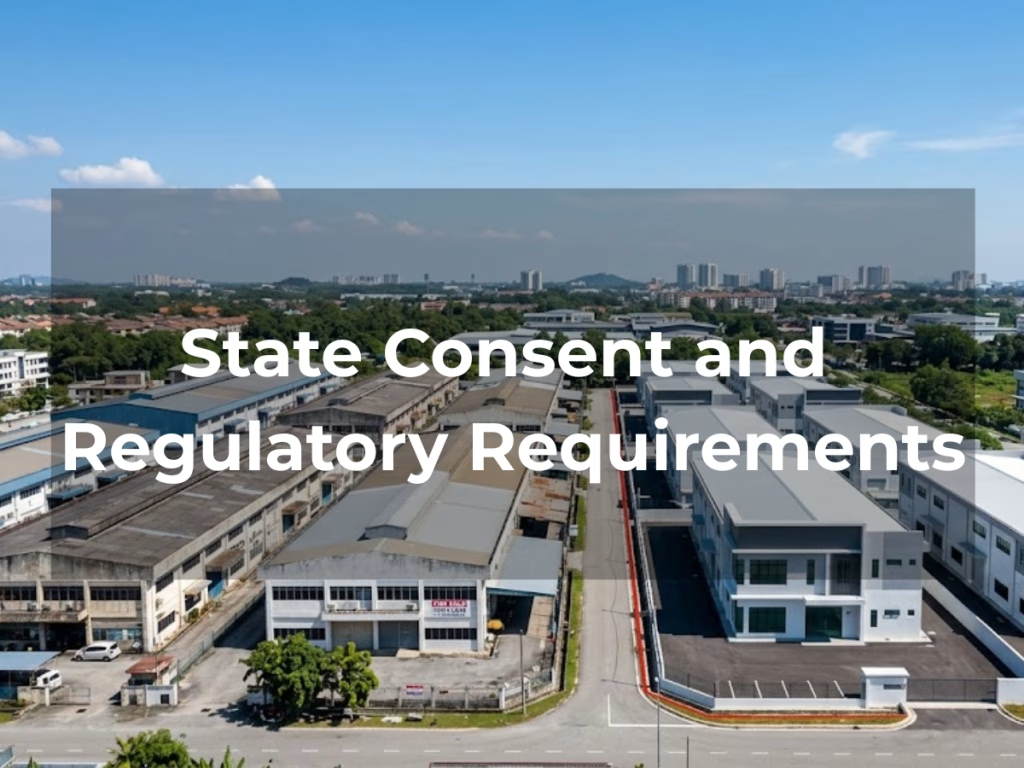
In Penang, leasehold industrial properties require state consent for several types of transactions including the transfer of ownership during a sale or purchase, the charge to a bank for a mortgage, any subdivision or partition of the property, any sublease or tenancy exceeding three years, and any material change of use. State consent is not automatic. The application process typically takes three to six months and incurs additional legal fees as well as a state levy, which is usually calculated as a percentage of the property value or a premium payment. While consent is rarely denied for straightforward industrial transfers, the possibility exists and the delays are certain.
Freehold properties generally do not require state consent for transfers between Malaysian citizens or locally incorporated companies, subject to standard bumi ownership policies that apply in Penang. This makes freehold transactions significantly faster, cheaper, and more certain than leasehold transactions. For foreign-owned companies or manufacturing operations with foreign shareholding, both freehold and leasehold may require state approval under Penang’s industrial land policies, but freehold approval is generally easier to obtain because the state has less ongoing interest in the property after the sale is completed.
When Leasehold Makes Practical Sense in Simpang Ampat
Despite the clear advantages of freehold ownership, leasehold is not automatically a poor choice. There are specific scenarios where leasehold makes practical or financial sense for the right buyer. If your business has a short-to-medium operational horizon of only ten to fifteen years, such as a specific project or contract-based manufacturing engagement, the lower upfront cost of leasehold may align well with your needs. If you are a capital-constrained startup or expanding SME that cannot afford the significant upfront premium for freehold, a leasehold factory allows you to enter property ownership at a lower price point, build equity over time, and potentially upgrade to freehold later when your financial position is stronger.
If you find a leasehold property with a very long remaining lease of eighty years or more, it is functionally similar to freehold for most business planning purposes, and the risk of lease decay is minimal within your working lifetime. Some speculators also target undervalued leasehold factories with fifty to sixty years remaining, aiming to flip them within three to five years for a trading profit, though this approach is speculative and requires market expertise. In rare cases, sellers may have already secured lease renewal terms from the state government, and if a leasehold property comes with a confirmed renewal at a known premium cost, the long-term risk is substantially reduced. However, for the majority of SME manufacturers seeking long-term operational and investment security in Simpang Ampang, freehold remains the superior choice.
A Practical Checklist for Evaluating Leasehold Factories
If you are considering a leasehold factory purchase in Simpang Ampang despite the drawbacks, there are several critical factors you should investigate before making an offer. First, verify the exact remaining lease term from the title document itself rather than relying on the seller’s representation. Second, check the lease commencement date, as this is essential for calculating the true remaining term accurately. Third, research the property’s renewal history, including whether it has been renewed before and at what premium cost.
Fourth, understand the Penang State Government’s current policy stance on industrial lease renewals, as policies can change with different state administrations. Fifth, compare the annual land tax or cukai tanah for leasehold versus freehold properties, as they may differ. Sixth, identify any additional consent requirements or restrictions such as bumi lot status or foreign ownership limits. Seventh, obtain an independent bank valuation that specifically accounts for lease decay in its assessment. Finally, compare the asking price against comparable freehold properties to determine whether the discount is truly sufficient to justify the lease limitations. You should never purchase a leasehold industrial property without independent legal advice that specifically reviews the lease conditions and remaining term.
Frequently Asked Questions (FAQs)
Can a leasehold factory in Simpang Ampat be renewed after expiry?
Yes, leasehold industrial properties in Penang can typically be renewed, but renewal is not automatic. The state government may impose a renewal premium often based on current market value, and legal fees and administrative charges apply. Renewal terms are negotiated at the time of expiry, and there is no guaranteed renewal right, which introduces uncertainty for long-term planning.
Are freehold factories in Simpang Ampat becoming rare?
Yes, freehold industrial properties in Simpang Ampat are becoming increasingly rare. Most new industrial land releases in mainland Penang are leasehold rather than freehold. Existing freehold industrial land is being slowly absorbed by buyers who recognize its long-term value. As supply diminishes, freehold premiums over leasehold are expected to rise further.
Can a foreign-owned company buy a freehold factory in Simpang Ampat?
Yes, but subject to state approval and minimum price thresholds set by the Penang State Government for foreign industrial property ownership. Conditions may include job creation requirements, technology transfer commitments, or minimum investment levels. Leasehold is sometimes easier to approve for foreign entities because the state retains ultimate ownership of the land.
Which banks offer financing for leasehold factories?
Most major Malaysian banks including Maybank, CIMB, Public Bank, RHB, and Hong Leong Bank finance leasehold industrial properties, but with stricter terms than freehold properties. The remaining lease must typically exceed fifty to sixty years for the bank to offer full loan-to-value ratios. Smaller banks or Islamic banks may have different policies, so shopping among multiple lenders is essential for leasehold purchases.
How does lease decay affect rental income if I lease out my factory?
Tenants generally care more about location, building condition, and functionality than the remaining lease term, unless the lease is very short, typically under thirty to forty years. However, when you eventually decide to sell the property, the buyer will heavily discount the remaining lease, which directly affects your exit value regardless of rental income performance.
Is it worth paying forty percent more for freehold?
For most SME manufacturers planning to operate from the same location for fifteen years or longer, yes. The long-term capital appreciation, operational certainty, financing advantages, and exit flexibility typically justify the premium. For shorter-term users, leasehold may be acceptable, but you should run your own financial projections based on your specific business timeline and growth plans.
What happens if the state refuses leasehold renewal?
If the state government refuses to renew a leasehold industrial property, the property reverts to the state. You may be compensated for the building structure but not for the land. While this is rare for actively used industrial properties, it remains a legal possibility. Freehold ownership carries no such risk of reversion.
Can I convert leasehold to freehold in Simpang Ampat?
Generally no. Leasehold to freehold conversion, known as alienation, is exceptionally rare in Penang, especially for industrial land. You should never purchase a leasehold property with the expectation or hope of converting it to freehold later, as this almost never occurs.
Making the Right Choice for Your Manufacturing Business
Simpang Ampat offers genuine opportunities for SME manufacturers to own industrial property in a growing corridor. But the freehold versus leasehold decision will shape your financial outcomes for decades to come. You should choose freehold if you plan to operate from the same location for fifteen years or more, if you want maximum capital appreciation, if you intend to pass the asset to your heirs, if you want the strongest financing terms available, and if you value operational certainty and complete control over your facility.
You should choose leasehold only if your capital is limited and freehold premiums are genuinely prohibitive for your current financial position, if your operational horizon is ten years or less, if you find a property with eighty or more years remaining at a compelling price, or if you have a clear exit strategy planned before lease decay accelerates beyond recovery. For most established SME manufacturers, freehold factory ownership in Simpang Ampat represents the superior long-term investment. The higher upfront cost is consistently offset by appreciation, financing advantages, and permanent operational security that leasehold simply cannot match.
Ready to Explore Factory Ownership in Simpang Ampat?
Whether you are prioritizing freehold for long-term wealth building or evaluating leasehold opportunities for capital-efficient entry, working with experienced industrial property specialists is essential to navigate the complexities of tenure, financing, and state consent requirements. Industrial Propstreet provides comprehensive listings of freehold and leasehold factories for sale in Simpang Ampat and across mainland Penang. Their team understands the nuances of industrial property investment and can help you identify opportunities that match your specific business needs and financial situation.
Browse available factories for sale through the Simpang Ampat factory listings on Industrial Propstreet’s website. For industrial properties nationwide, explore the main Industrial Propstreet portal. Take the next step toward owning your manufacturing facility today. The right freehold or leasehold factory in Simpang Ampat could be the foundation of your business’s next growth phase.